Safe Budgie Toys: What to Buy, Make and Avoid
A budgie can spend a surprising amount of time investigating a small piece of paper, climbing across a natural branch or working out how to reach a bit of food. The best toys encourage these behaviours without putting the bird at risk.
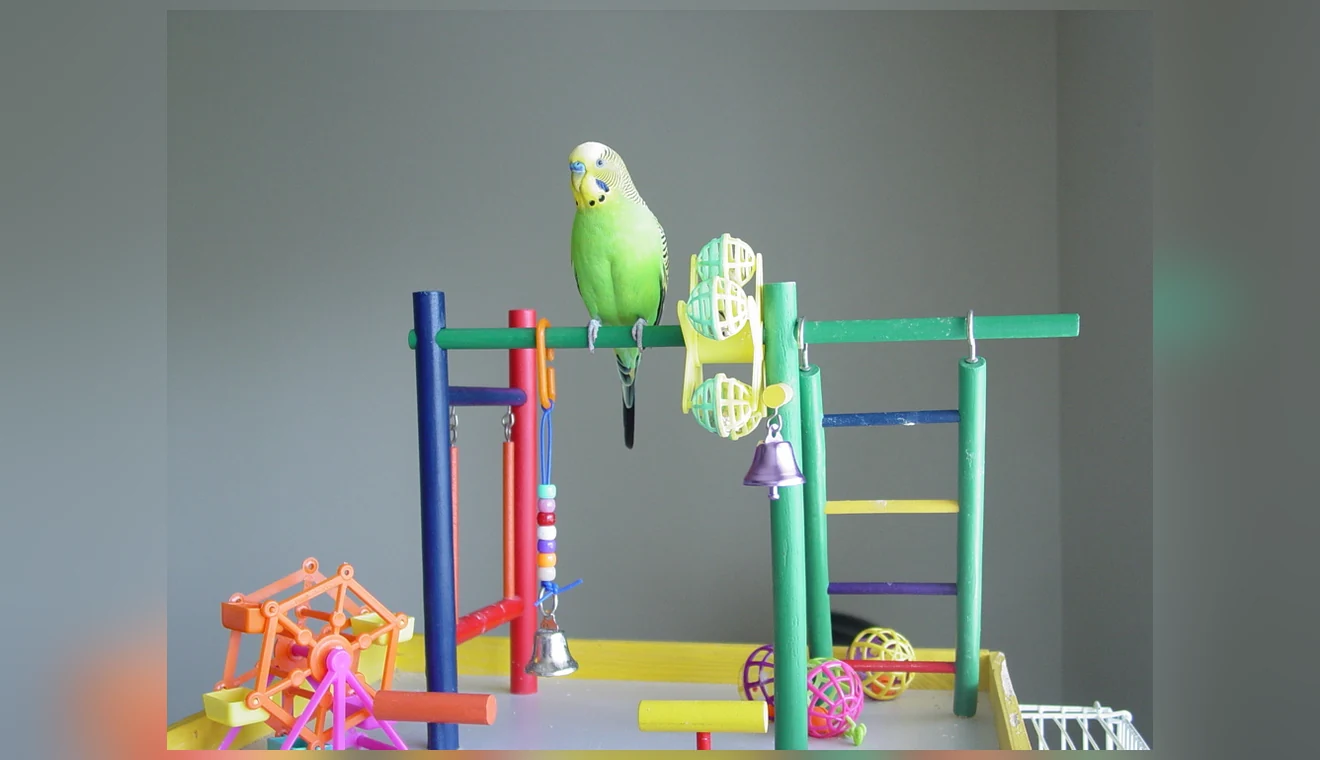
Safe budgie toys are appropriately sized, non-toxic, easy to inspect and matched to the bird's normal activities. A brightly coloured toy marketed for parrots is not automatically suitable for a budgerigar, and a cage full of toys is not a replacement for space to move and fly.
Here's how to choose and rotate useful toys for budgies in a UK home.
What does a budgie actually need from a toy?
Budgies naturally explore, forage, chew, climb, fly and interact with other birds. A good toy offers one or more of these opportunities.
Think about the purpose rather than the price. A shreddable paper item encourages exploration and beak use. A well-positioned perch provides a route across the enclosure. A simple foraging toy makes the bird work gently for a small part of its usual food.
The RSPCA recommends toys made from safe, non-toxic materials, including suitable untreated wood, paper and cardboard. It also advises giving birds regular opportunities for play, climbing and foraging.
Offer choices, but preserve open space so your budgie can spread its wings and move freely.
Safe materials for budgie toys
| Material | Suitable use | Important checks |
|---|---|---|
| Untreated, bird-safe wood | Chew blocks, perches and simple hanging toys | No unknown preservatives, paint, sharp splinters or glue |
| Plain, uncoated paper | Shredding and simple foraging puzzles | No staples, sticky tape or inks of uncertain safety |
| Clean cardboard | Small boxes, folded foraging pockets | No plastic lining, staples or exposed adhesives |
| Suitable natural branches | Chewing and climbing | Correct tree species, pesticide-free, appropriately prepared |
| Bird-safe stainless-steel fittings | Durable hangers and connectors | Closed securely, no sharp edges or entrapment gaps |
| Purpose-made, suitable natural fibres | Some supervised climbing or shredding uses | Inspect for fraying and remove loose loops |
There is no reliable rule that all “natural” materials are safe. Unknown twigs, garden plants and craft materials may be treated or toxic.
Avoid choosing a toy solely by an online seller's “non-toxic” label when the materials aren't identified. Buy from reputable bird suppliers who can explain what it contains.
Foraging toys that are worth trying
Budgies don't need expensive electronic puzzles. Start with something simple, such as a few pieces of their normal food tucked into clean plain paper or a shallow, stable foraging tray.
The bird should be able to reach the food without getting tangled, trapped or frustrated. Make the first attempts easy and build complexity only when the bird enjoys the activity.
Scatter a small amount of suitable seed or other approved food among safe paper pieces in a tray. Count it as part of the daily diet rather than adding unlimited extra treats.
A budgie that ignores a new puzzle isn't being stubborn. It may need time to investigate the object, or it may simply prefer a different activity.
For a bird that is nervous around unfamiliar objects, put the item outside the cage at first where it can observe it. Move it closer in stages.
Shredding toys and chewable items
Plain paper strips, suitable cardboard and untreated wood can give budgies something to investigate and destroy safely. Inspect them daily for loose fibres and small parts that could be swallowed.
Avoid glossy, coated or heavily printed materials unless the manufacturer can confirm suitability. Do not reuse packaging containing chemical residues or food grease.
Some birds chew more enthusiastically than others. Replace pieces that are soggy, dirty or falling apart into unsafe components.
A practical home-made option is a small folded paper parcel containing a little of the bird's usual food, with loose folds rather than tape or staples. Watch the bird's first attempts and remove anything it tries to swallow inappropriately.
Climbing toys and perches
Bird-safe ladders, natural branches and simple swings can encourage movement between areas. They should be stable enough that the bird can land and climb without slipping or getting a toe trapped.
Use perches with varied appropriate diameters and natural textures. Uniform smooth plastic bars across the entire cage do not offer much variety.
Check spacing between ladder rungs and hanging objects. A budgie's head, wing or foot should not be able to become wedged in a gap. If a toy swings into the wall or blockades a feeding station, rearrange it.
Leave enough open space for flight. The RSPCA highlights the importance of safe opportunities for birds to fly outside their enclosure as well as enriching the inside.
Are mirrors safe for budgies?
A mirror is not a substitute for social companionship. Some birds become persistently focused on their reflection, court it or treat it as a real partner.
If your budgie becomes preoccupied, regurgitates repeatedly towards the mirror or neglects other activities, remove it and assess social and environmental needs. Mirrors can also have sharp edges or insecure mounts.
It's better to provide appropriate bird companionship, foraging opportunities, natural perches and time in a safe flight area than to depend on a mirror as the main form of entertainment.
What about bells, rings and plastic toys?
These items vary greatly. A bell with an exposed internal clapper, loose split ring or poorly fitted connector may trap a beak, toe or tongue. A robust toy designed specifically for small birds is different from a cheap decorative bell.
Inspect every attachment. Avoid open split rings, sharp metal edges, poorly fixed beads and parts small enough for the bird to break off and swallow.
Plastic isn't automatically unsafe, but brittle plastic that cracks into sharp fragments is unsuitable. Remove damaged toys immediately.
Never assume an item is safe simply because a picture shows a budgie using it.
Rope and string: use particular care
Fraying ropes, long loops and loose fibres can be hazardous. They may entangle toes or legs, and swallowed fibres may cause digestive problems.
The RSPCA includes some short natural-fibre toys among enrichment ideas, but suitability depends on the construction and the bird. For a budgie that picks fibres apart, a solid wooden or paper toy may be the safer choice.
Remove any rope toy that is fraying, shedding strands or creating loops. Keep hanging materials short, secure and under regular inspection.
Do not leave long strings, sewing thread or elastic bands inside the cage as improvised toys.
How many toys should a budgie have?
Enough to offer variety without crowding. Two or three different activities in a suitable enclosure can be more useful than covering every bar with hanging products.
Rotate some toys every week or two, but keep familiar perches and safe resting spaces stable. A nervous bird may need new items introduced slowly.
Watch what your budgie actually uses. A foraging tray it returns to each day has more value than an expensive glittery toy it avoids.
Our budgie body language guide helps you recognise when play is relaxed and when something may be worrying the bird.
DIY budgie toy safety checklist
Before putting a new toy into the enclosure, check:
- Are the wood, paper, colouring and any adhesive demonstrably bird-safe?
- Could a foot, neck, tongue or wing become trapped?
- Are there loose loops, fibres, split rings or sharp ends?
- Can the bird reach the food and water without obstruction?
- Can you remove and clean it easily?
- Is it an appropriate size for a budgie rather than a much larger parrot?
- Can you supervise its first use to spot problems?
If the origin or material is uncertain, don't use it.
Frequently asked questions
Can budgies play with toilet-roll tubes?
Plain, clean cardboard tubes may provide a shredding or foraging activity if they have no hazardous glue, coating or attachments. Remove them if the bird begins eating large pieces.
Do budgies need toys every day?
They need daily opportunities for normal behaviour, including social interaction, movement and foraging. Toys are one way to provide those opportunities, but they are not the whole solution.
What if my budgie is scared of a new toy?
Move it away, let the bird observe it and introduce it slowly. Never force contact or block its escape route.
Can I hang toys over a perch?
Only if they leave adequate clearance and cannot fall or tangle around the bird. Keep main landing and sleeping perches unobstructed.
Choose toys for the bird, not the photograph
A good toy makes a budgie's day more interesting without restricting movement or creating unnecessary hazards. Start with safe natural materials, one easy foraging activity and plenty of space.
Keep inspecting toys and changing them as they wear. The simplest cardboard puzzle or bird-safe branch may provide more enrichment than a whole shopping basket of unsuitable gadgets.
Sources and further reading
- RSPCA: Enrichment for pet birds — safe toy materials, chewing, foraging and climbing.
- RSPCA: Housing and environments for pet birds — safe flight and an enriched bird environment.