Hamster Wheel Size Guide: Which Wheel Is Right for Your Hamster?
A hamster wheel is one of those purchases where a few centimetres make a big difference. Many wheels supplied with starter cages are small, and a hamster will often keep running in one even when the wheel makes it bend its back.
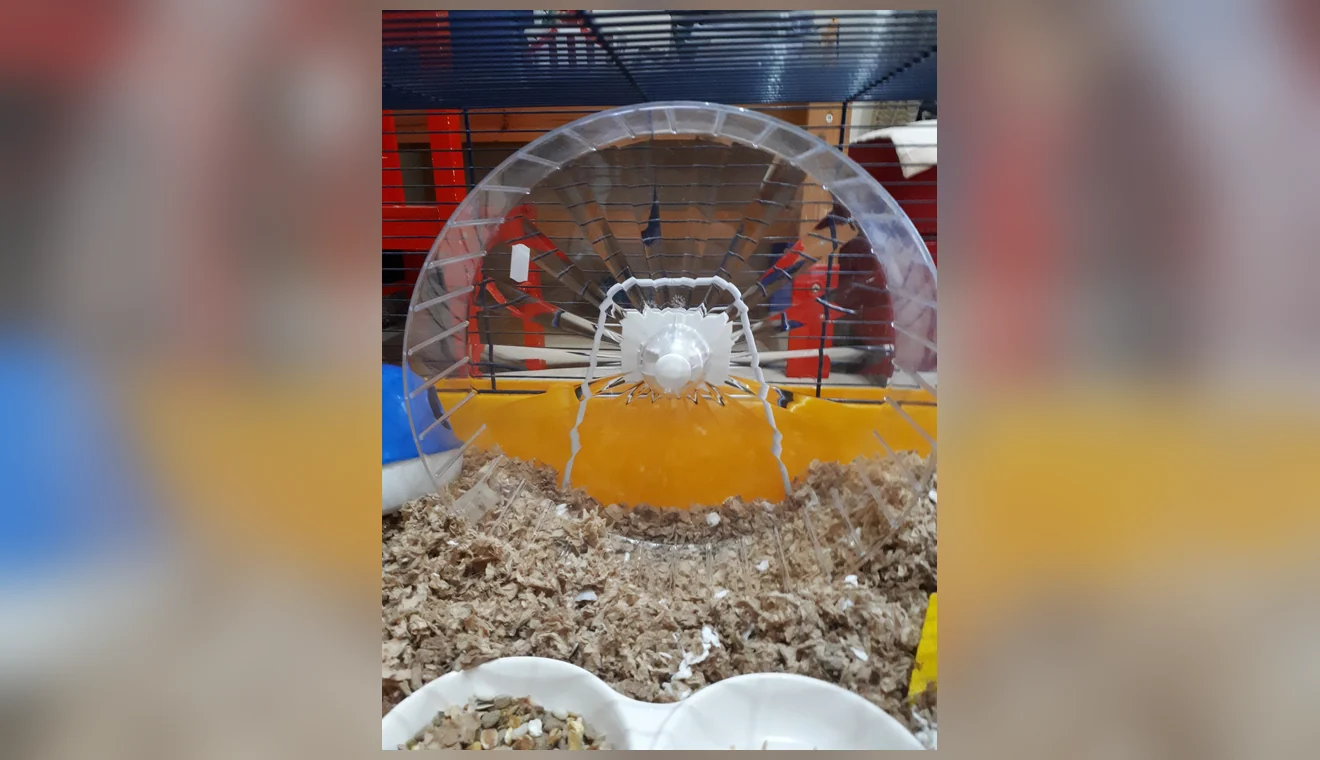
The right hamster wheel is upright, solid-surfaced, secure and large enough for your hamster to run with its back comfortably straight. For a Syrian, start by comparing wheels in the 27–32 cm range; dwarf species need their own appropriate sizes, listed below. That matters more than colour, branding or whether the box says “suitable for hamsters”.
Here's how to choose one for Syrian, Chinese, Roborovski and other dwarf hamsters, including what to watch for once it's in the enclosure.
Hamster wheel sizes by species
Blue Cross offers the following species-appropriate diameter ranges. Treat them as a starting point, not a promise that every individual will fit the smallest size listed.
| Hamster species | Blue Cross suggested upright wheel diameter |
|---|---|
| Syrian | 27–32 cm |
| Chinese | 25–27 cm |
| Campbell's dwarf | 22–25 cm |
| Winter white dwarf | 22–25 cm |
| Roborovski | 20–22 cm |
Woodgreen recommends a 12-inch (about 30 cm) solid upright wheel for Syrian and Chinese hamsters, and an 8-inch (about 20 cm) wheel for other hamsters. Its guidance differs from Blue Cross in some details, which is why observing the animal is essential.
When your budget and enclosure allow, a suitably larger wheel is usually worth considering. Check that your hamster can rotate it easily; an oversized, stiff wheel can be frustrating too.
Syrian hamster wheel size
For a Syrian, aim around 28–30 cm or larger as needed, with a solid surface and stable mounting. Many Syrian hamsters are substantially larger than dwarf species, so the small wheel bundled with a cage is rarely an appropriate permanent choice.
Watch your hamster run at normal speed. The back should remain relatively straight rather than forming a pronounced arch.
Chinese hamster wheel size
Chinese hamsters have a longer body shape than many people expect. Some UK welfare guidance recommends the same 30 cm class of wheel often chosen for Syrians, while other guidance provides a slightly smaller range.
Start with the animal's actual body length and posture, not just the category “dwarf hamster” used in a shop.
Roborovski and other dwarf hamsters
Roborovski hamsters are small and fast, but that doesn't mean a tiny wheel is safe. A 20–22 cm diameter is a commonly cited starting range for Roborovskis; Campbell's and winter whites may need 22–25 cm or more.
A very lightweight wheel can spin excessively or wobble. Look for smooth movement with enough control for the hamster to enter and stop safely.
How to tell if a hamster wheel is too small
The easiest test is to watch the hamster use it while fully awake, preferably during the evening when it chooses to be active.
Look for these clues:
- The body forms an obvious arch while running.
- The head is held unnaturally high or low to fit inside the wheel.
- The hamster keeps its body twisted to one side.
- The running surface is too narrow for a natural stride.
- The wheel squeaks, jerks, tilts or wobbles under the animal.
You may not notice all of these every time. A hamster that runs enthusiastically on a poor wheel isn't necessarily comfortable. Some animals will use whatever exercise opportunity they have.
If the posture looks wrong, replace the wheel with a suitable larger model. Don't try to compensate with extra playtime in a ball.
Solid wheel versus wire or mesh wheel
Choose a continuous solid running track. Open wire rungs and metal mesh can catch feet or cause injury, and spoke arrangements can create dangerous pinch points.
A good upright wheel has a smooth, washable surface with enough traction to run without slipping. Avoid sharp joins, exposed screws inside the running area and gaps where toes or legs might become trapped.
Some wooden wheels use cork running surfaces. These can be pleasant underfoot, but check for splinters, exposed adhesives and how thoroughly they can be cleaned if the hamster urinates while running.
Plastic wheels can be easy to clean, provided the material is sturdy and free of sharp seams.
Upright wheels and flying saucer wheels
A conventional upright wheel lets a hamster run on a curved, vertical track. This is generally the safer primary choice when it is correctly sized and supported.
A flat or tilted flying-saucer style wheel can cause an animal to curve sideways during running, especially if the disc is too small. It should not be assumed to replace a properly fitted upright wheel.
The same goes for exercise balls. Blue Cross and Woodgreen advise against hamster balls because they can be stressful, restrict normal exploration and have potential injury hazards.
A secure playpen with hides and opportunities to explore is a better alternative for supervised exercise outside the enclosure.
Make sure the wheel fits the enclosure
Before ordering, check three measurements: diameter, overall height including its stand, and depth. A 30 cm wheel may need more than 30 cm of clearance once its frame and mount are included.
Deep bedding is essential for burrowing. You should not have to remove most of the bedding merely to squeeze a big wheel into a too-small cage.
Place the wheel on a stable platform or a solid part of the enclosure base so it cannot sink into a tunnel. Check that its support does not create a dangerous heavy object above burrowing areas.
Leave space for other essentials: deep substrate, hides, a food-foraging area and a safe sand bath. Our Hamster Enrichment Ideas guide explains how to make the whole home more useful than just adding exercise equipment.
What if the wheel is noisy?
Noise can mean loose fittings, a worn bearing or the wheel touching the cage wall. Check that the frame is level and the mount is secure.
An animal running at night is normal. Hamsters are most active in the evening and overnight, so moving the enclosure to a suitable quieter room is usually a better response than removing the wheel.
Don't apply household oils, sprays or lubricants that could expose the hamster to unsafe chemicals. Follow the manufacturer's maintenance advice.
If a wheel has cracks, rough edges or a dangerous wobble, replace it rather than trying to force it straight.
Cleaning and checking the wheel
Inspect the running surface daily. Some hamsters urinate while exercising, so clean any soiled area with an appropriate pet-safe method and dry it thoroughly before replacing it.
A weekly closer check is useful. Feel for sharp edges, test the bearing, inspect the underside and ensure the mount hasn't loosened.
If you choose a wooden or cork-lined wheel, consider whether the surface can be safely cleaned and dried. Persistent urine contamination can make a supposedly high-end wheel less hygienic than a simpler washable option.
Is more wheel time always better?
A wheel is important exercise equipment, but it's only one part of the habitat. Hamsters also need to dig, forage, nest, hide and choose when they want to be active.
If an animal seems to spend nearly every waking moment trying to escape or performing repetitive movements, review the enclosure's space and enrichment rather than assuming it simply loves running.
Read our Hamster Sand Bath Guide for another useful activity that doesn't involve a wheel.
Never wake a hamster during the day just to prove the wheel is being used. You can inspect it after the hamster has naturally gone to sleep.
Common hamster wheel buying mistakes
Buying the wheel that comes with a small cage
Starter kits often prioritise price and fitting everything into a compact box. Check the actual wheel diameter.
Choosing a wheel by age alone
A growing hamster may outgrow a wheel quickly. Research adult size and buy with the animal's future needs in mind.
Ignoring the stand and available clearance
The wheel may be the right diameter but still be unusable because the roof, bedding or décor blocks it.
Choosing looks over a solid running surface
A themed wheel with open rungs, gaps or a narrow track isn't a good bargain.
Assuming running proves the wheel is safe
A hamster may continue running in an unsuitable wheel. The better test is posture, stability and condition of the equipment.
Questions about hamster wheel sizes
Is a 20 cm wheel big enough for a Syrian?
No. It is below the species-appropriate range given by Blue Cross and is likely to make a Syrian bend unnaturally during running.
Can a hamster have a wheel that's too big?
A wheel can be unsuitable if the hamster cannot turn it easily, if it's unstable or if it leaves no space for other important housing needs. Size and function both matter.
Do I need a separate wheel for every hamster?
Syrian hamsters should live alone. Housing other species together has significant risks and is not an enrichment shortcut. Seek reputable species-specific guidance rather than using extra wheels to justify overcrowding.
Why is my hamster running at night?
That's normal. Hamsters are naturally active when people are often asleep. Avoid disturbing them during their rest period.
The easiest decision in the shop
Take the species guidance as a starting point, choose a solid upright wheel, measure whether it will fit properly and watch how your hamster actually runs.
A comfortable straight-backed stride is the goal. If you can't provide a suitable wheel and enough room for bedding and hides in the same enclosure, the enclosure itself may need improving.
Sources and further reading
- Blue Cross: Hamster Care — species-specific wheel diameter ranges and risks of unsuitable wheels.
- Woodgreen: Caring for Hamsters — exercise, bedding and enrichment.
- Woodgreen: Make Your Hamster Feel at Home — fitting exercise equipment into a suitable enclosure.